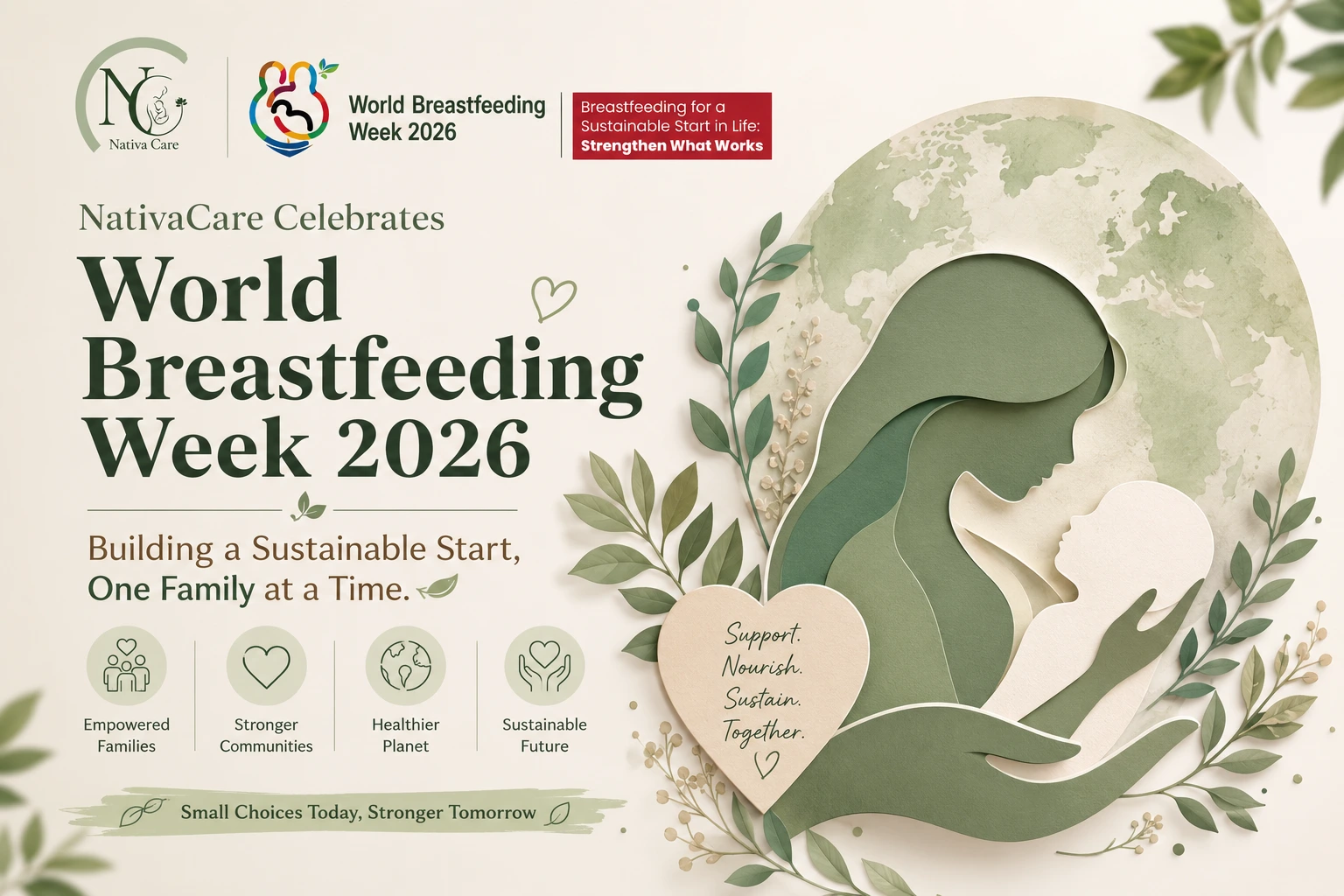
There is a particular kind of quiet that fills a home in the first days after a baby arrives. It is not always a peaceful quiet. Sometimes it is the quiet of a mother sitting alone at 3 a.m., baby at her breast, wondering if she is doing this right. Sometimes it is the quiet after visitors have gone home and the real work of learning to feed a newborn begins. As NativaCare, we have sat in that quiet with hundreds of families in Abu Dhabi, and it is exactly why World Breastfeeding Week means something real to us, not just a date on the calendar, but a chance to talk honestly about what mothers actually need.
This year’s global theme, “Sustainable Start in Life: Strengthen What Works,” feels almost like a relief after years of campaigns that focused heavily on telling mothers what they should do. This year, the conversation shifts. It asks a better question: what do we already know works, and how do we make sure every mother actually gets it?
As NativaCare, we want to spend this week doing exactly that, looking honestly at what support makes the biggest difference, and committing ourselves to bringing more of it into homes across Abu Dhabi.
It is easy to reduce breastfeeding to a single decision made in a hospital bed. In reality, it is a relationship, one that develops over weeks, shaped by biology, environment, sleep, stress, support, and a thousand small adjustments a mother makes without anyone noticing.
Breast milk is remarkable in what it offers. It is uniquely suited to a baby’s nutritional and developmental needs, changing in composition as the baby grows to match exactly what that stage of development requires. The World Health Organization recommends that breastfeeding begin within the first hour of life, continue exclusively for the first six months, and carry on alongside complementary foods up to two years of age or beyond. Behind that guidance sits a large and consistent body of evidence: breastfeeding supports a baby’s immune protection and is linked to lower rates of several childhood infections. Mothers, too, experience real health benefits from breastfeeding, not just their babies.
There is also a dimension to breastfeeding that rarely gets discussed at the kitchen table but deserves more attention: its environmental footprint. Breast milk needs no factory, no packaging, no supply chain, and no transportation. It is produced by the body, for the body, in real time. In a world increasingly conscious of sustainability, breastfeeding is one of the few truly renewable resources tied to something as fundamental as feeding a child.
Put together, these facts explain why breastfeeding sits at the centre of what “a sustainable start in life” really means, not just a healthier beginning for an individual baby, but a lower-impact, more resilient way of nourishing the next generation altogether.
Here is the part of the conversation that often gets skipped: breastfeeding may be natural, but it is not automatic. It is a skill one that a mother and her baby learn together, through trial, adjustment, and often a fair amount of frustration before it clicks.
The research on this is remarkably consistent. When mothers receive appropriate, skilled breastfeeding support, they are far more likely to establish breastfeeding successfully and continue it for as long as they intend to. The challenge has never really been a lack of evidence. It has been access, making sure that support reaches mothers at the moments they need it most.
And those moments rarely happen inside a hospital room. They happen at home, often late at night, often alone, when a mother finds herself asking: Is my baby getting enough milk? Is this latch actually correct, or does it just feel wrong because it’s new? Why does feeding hurt so much when everyone said it wouldn’t? How often should a newborn actually be feeding? Is any of this normal?
This is precisely where “Strengthen What Works” becomes more than a theme, it becomes a responsibility. The support that actually moves the needle for mothers tends to start long before the baby is even born, with real antenatal education offered during pregnancy rather than a rushed conversation squeezed in after delivery. It continues in the earliest hours after birth, when skin-to-skin contact and early initiation, done when it is clinically appropriate, help mother and baby find their rhythm together. It shows up in the practical, hands-on moments too, someone gently adjusting how a baby is positioned and attached at the breast so that feeding stops being painful and starts feeling manageable, and someone helping a mother notice her baby’s early hunger cues before frustration and tears take over.
It shows up when a mother isn’t simply discharged and left to figure things out alone, but has genuine continuity of care once she is home. And it shows up in the wider environment around her, a family, a household, a community that protects and encourages her feeding choices instead of adding pressure or doubt.
None of this is new information. What is new, what this year’s theme is really pushing for, is a stronger commitment to closing the gap between knowing what works and actually delivering it to every mother who needs it.
If there is one moment in the breastfeeding journey that deserves far more attention than it gets, it is the transition from hospital to home.
In the hospital, a mother is surrounded by professionals. Nurses check in. Lactation consultants are a call button away. There is structure, and there is help within arm’s reach. Then she goes home, and all of that support often disappears overnight, right at the moment when the real learning curve begins.
This is, without question, one of the most vulnerable stretches of early motherhood. The adrenaline of birth has faded. Sleep is fragmented. Hormones are shifting. And in the middle of all of that, a mother is expected to master something as delicate and physically demanding as breastfeeding, often with no one beside her who actually knows what they’re looking at.

Our qualified midwives, lactation specialists, and consultants bring professional breastfeeding support and postnatal support directly into a mother’s home in Abu Dhabi. We do not walk in with a checklist and a one-size-fits-all routine. We sit with the mother. We watch how she and her baby are actually feeding together, not how a textbook says it should look, but how it is genuinely unfolding in her home, on her schedule, with her baby.
From there, the support becomes personal. It might mean adjusting positioning so a feed stops hurting. It might mean helping her recognize her baby’s hunger cues before crying starts. It might mean guidance on expressing milk, easing maternal discomfort, or simply helping her understand that what she’s experiencing, the uncertainty, the exhaustion, the second-guessing, is far more common than she realizes.
And underneath all of it, we are building something that cannot be measured in millilitres or feeding charts: confidence. A mother who feels confident in her ability to feed her baby is a mother who is far more likely to continue breastfeeding for as long as she chooses to.
This is exactly why, this World Breastfeeding Week, we at NativaCare proudly join the global call for a Sustainable Start in Life: Strengthen What Works. It reflects what we see every day in homes across Abu Dhabi, that mothers do not need to be told breastfeeding matters. They need someone beside them who can help make it possible. Because when we strengthen the support surrounding a mother, we strengthen the start we give to the next generation.
There is a version of breastfeeding advocacy that, however well-intentioned, ends up making mothers feel judged rather than supported. We want to be clear about where we stand on this, because it matters.
Promoting breastfeeding should never mean placing guilt on a mother whose feeding journey looked different from what she had originally planned. Every mother’s circumstances are her own. Medical conditions, birth experiences, maternal mental health, a baby’s individual needs, and personal choice all shape how a family feeds their child, and none of those reasons require justification.
Evidence-based maternity care means giving mothers accurate information and skilled, hands-on support. It also means respecting a mother’s right to make informed decisions about how she feeds her baby, without judgement attached to whichever path she chooses.
A truly sustainable start in life is not only about the milk. It is about the mother behind the feeding journey, her wellbeing, her confidence, and her right to be supported rather than scrutinized.
World Breastfeeding Week gives the world a moment to pause and talk about breastfeeding publicly. But the support that actually changes outcomes for mothers doesn’t live inside a single week, it lives in the quiet, ongoing moments that happen long after the campaign banners come down.
It happens when a mother receives real breastfeeding education while she is still pregnant, before exhaustion and uncertainty have set in.
It happens when someone sits beside her during those first, difficult feeds and helps her find a position that finally feels comfortable.
It happens when she goes home from the hospital and knows exactly who to call when a question keeps her up at night.
And it happens when healthcare professionals, families, and communities work together not in isolation, to build an environment where mothers feel informed, supported, and genuinely confident in the choices they are making.
This is the work. Not a single week of awareness, but a sustained, practical commitment to strengthening the systems already proven to help.
Supporting mothers. Nurturing families. Building a healthier and more sustainable future.
Nativacare is your trusted support system led by experienced community midwives for your extraordinary motherhood journey. We at NativaCare believe that the positive motherhood outcome is not a probability but a possibility. Unlock your potential and change your attitude to change your altitude.
YES YOU CAN DO IT.
C2 Bateen tower, 6, Al Hirdiyah Street, 10th Floor, Abu Dhabi
This will close in 0 seconds
This will close in 20 seconds