It’s usually a quiet moment that brings the question up. You’re feeding your baby at 3 a.m., scrolling through your phone for company, and you read a headline: breastfeeding lowers breast cancer risk. Part of you feels a small spark of pride. Another part, maybe a louder one, feels a pang. What if you only
Congestion is the early heaviness and fullness that comes as your milk arrives, engorgement is when the breasts become hard, tight and painful from that fullness, and mastitis is inflammation of the breast tissue that can make you feel properly unwell, sometimes with a fever. All three can feel alarming. Only a doctor can tell
Somewhere around week 13 or 14, something shifts. The nausea that made certain smells unbearable starts to fade. The exhaustion that had you asleep by 8 p.m. lifts, just a little. You catch yourself feeling, for the first time in weeks, almost like yourself again, except now there’s a small, undeniable curve where your waistband
Nobody quite prepares you for how much you bleed after birth. You braced yourself for labour, for the baby, for those early sleepless nights, and then you stand up for the first time after delivery and think, quietly panicking, “is this normal?” Then it happens again on day ten, a sudden gush that seems heavier
You’re sitting through another routine antenatal appointment, feeling completely fine, no symptoms, nothing unusual, when your midwife lets you know your doctor will be booking your glucose test soon. And suddenly the word “diabetes” is floating around a pregnancy that felt totally normal five minutes ago. The mind jumps fast: did I eat too much
Somewhere in your ninth month, alongside the nesting and the hospital bag, you may have come across a practice that sounds almost too simple to be useful: hand-expressing tiny drops of colostrum from your breasts before your baby is even born, and freezing them in syringes for later. It’s called antenatal colostrum expression, and it’s
Somewhere around week 28, pregnancy stops feeling like something happening to you in the background and starts feeling like a genuine countdown. The appointments get closer together, your body gets louder about reminding you it’s working hard, and a question starts running quietly under everything else: how will I know when it’s actually time? The
Two pink lines change everything before your body’s even had time to catch up. One minute you’re going about a normal week, the next you’re lying awake wondering if that twinge is normal, whether the wine you had last month before you knew matters, and whether you’re supposed to be doing something official by now.
Let’s answer this one right at the top, because it’s exactly the kind of question that deserves a straight answer before anything else: no, a doula cannot replace a midwife. A doula is not a medical professional, cannot deliver a baby, and is not trained or permitted to manage the clinical side of your pregnancy
At some point in your pregnancy research, you’ll come across both words in the same sentence “hire a doula,” “find a midwife“, often used almost interchangeably, as if they’re two names for the same kind of support. They’re not, and the difference actually matters quite a bit once you understand it. One is a clinician.
You spent nine months preparing for birth. The classes, the hospital bag, the playlist for labour, the nursery corner you rearranged four times. And then the baby arrives, and somewhere between the last contraction and the first sleepless night, you realise nobody actually prepared you for this part, the part where you’re still bleeding, still
Your baby is fussy at the breast, feeding every hour, and won’t settle no matter what you try. Somewhere between exhaustion and 3am panic-googling, a diagnosis starts to form in your head: not enough milk. Or maybe it’s tongue-tie. Or maybe you already gave one bottle of formula last week and now you’re convinced you’ve
There’s a specific kind of overwhelm that comes with being pregnant far from home. It’s not just the usual first-time-mother nerves, it’s googling “hospital vs clinic Abu Dhabi” at 11pm, wondering if your insurance actually covers a C-section, and realising your mum, who’d normally be three streets away with a casserole and a hundred opinions,
There’s a moment almost every family has, somewhere in the first weeks with a newborn: handing the baby over to a nanny for the first time and feeling that flicker of “does she actually know what she’s doing?” It’s not a lack of trust exactly, it’s the sudden, sharp realization that “great with kids” and
Somewhere around day four or five after birth, it hits, a wave of tearfulness that seems to come from nowhere, over something as small as your baby’s socks not matching. Everyone around you nods knowingly and says “ah, that’s just the baby blues.” And for most mothers, that’s exactly what it is: a wave that
Nobody warns you properly about this part. You spent months picturing the feeding itself as the easy bit, the labour was supposed to be the hard part, and then your baby latches on and it feels like glass. You grit your teeth through a feed, check the clock, dread the next one starting in two
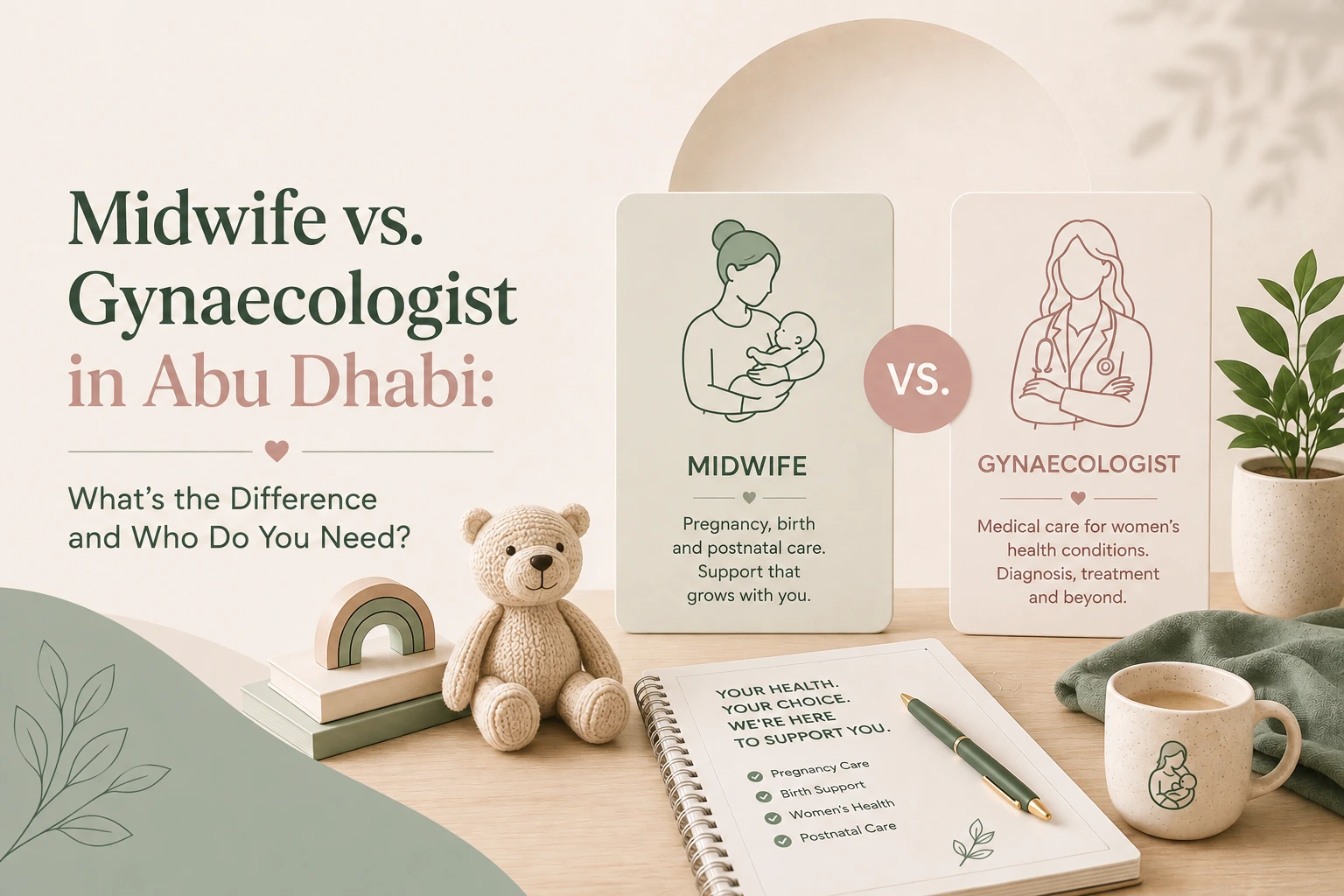
You’ve just found out you’re pregnant, and within about twenty minutes of googling “next steps,” you’ve hit a wall of terminology that nobody stops to explain: OB/GYN, midwife, obstetrician, gynaecologist, sometimes all used as if they mean the same thing. Then someone in your mums’ WhatsApp group mentions their “independent midwife” like it’s an entirely
At some point in your pregnancy, usually in a WhatsApp group, a waiting room, or a well-meaning comment from someone who heard it from someone else, you’ll hear it: “did you know breastfeeding is actually the law here?” And if you’re anything like most new mothers in the UAE when they first hear it, that
There is a particular kind of quiet that fills a home in the first days after a baby arrives. It is not always a peaceful quiet. Sometimes it is the quiet of a mother sitting alone at 3 a.m., baby at her breast, wondering if she is doing this right. Sometimes it is the quiet
Nativacare is your trusted support system led by experienced community midwives for your extraordinary motherhood journey. We at NativaCare believe that the positive motherhood outcome is not a probability but a possibility. Unlock your potential and change your attitude to change your altitude.
YES YOU CAN DO IT.
C2 Bateen tower, 6, Al Hirdiyah Street, 10th Floor, Abu Dhabi
This will close in 0 seconds
This will close in 20 seconds